Every lead scoring model I’ve inherited had the same shape: a spreadsheet of attributes, a weight next to each one, and a total out of 100. Nobody remembered where the weights came from. Everyone trusted the number anyway.
So we checked. Two quarters of data, 4,812 accounts, and one question: does a higher score actually mean a higher chance of booking a meeting?
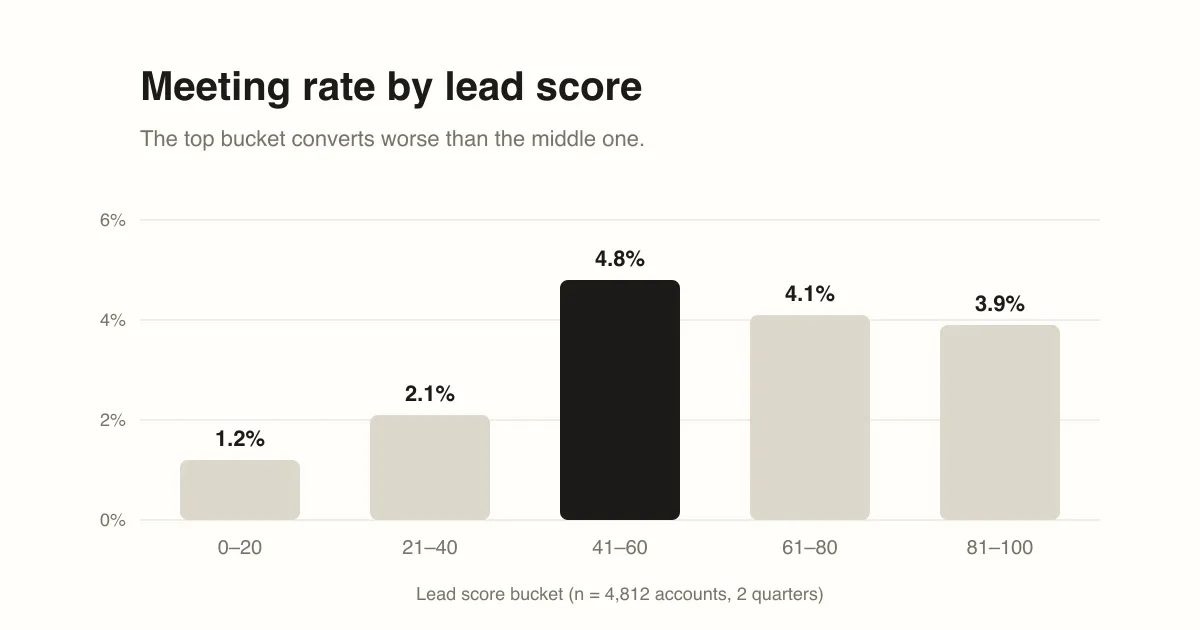
Mostly yes — until the top. The 41–60 bucket booked meetings at 4.8%. The 81–100 bucket, the one reps were told to call first, sat at 3.9%.
Why the top bucket underperforms
When we looked at who was scoring 90+, a pattern jumped out. The model rewarded company size and tech stack match heavily. That put large enterprises with the “right” tools at the top. Those accounts:
- already had a vendor for what we sell
- had procurement cycles longer than our quarter
- received the same outreach from every competitor using the same scoring logic
The model wasn’t wrong about fit. It was wrong about timing and competition — two things a static attribute score can’t see.
Fit is not intent
The fix wasn’t to throw the model away. It was to split it in two:
- Fit score — does this account look like our best customers? Firmographics, stack, size. Changes slowly.
- Timing score — is something happening right now? Hiring for a relevant role, a new leader in the buying team, a funding round, a competitor contract coming up for renewal. Changes weekly.
Reps now work a matrix instead of a ranked list: high fit + high timing first, high fit + low timing goes into a nurture sequence instead of a cold call.
Recalibrate against outcomes, not opinions
The most useful habit we picked up: every quarter, re-plot score against meeting rate. If a bucket isn’t converting, the weights get adjusted based on what closed — not on what the team thinks should matter.
The uncomfortable part is how often intuition was wrong. “Uses Salesforce” was weighted heavily for two years. It turned out to have almost no relationship with booking a meeting.
Takeaway
A lead score is a hypothesis, not a fact. If you’ve never checked it against what actually converted, you don’t have a scoring model — you have a list of opinions with decimals.